16 Aug CT Scan vs. MRI: What’s the Difference and Which One Do You Need?
What Is a CT Scan?
A CT (computed tomography) scan uses a series of X-ray images taken from different angles. A computer combines them into cross-sectional “slices” of the body, which can also be assembled into 3D views.
During a CT scan, you lie on a table that moves through a wide, ring-shaped scanner. The scan itself is usually quick, which makes CT useful when fast answers matter or when a patient has difficulty lying still for long periods.
CT scans are commonly used to evaluate:
- Bone fractures and complex joint injuries
- The chest and lungs
- The abdomen and pelvis, including kidney stones
- Sinus conditions
- Internal bleeding or injuries after trauma
- Blood vessels, when contrast is used
What Is an MRI?
An MRI (magnetic resonance imaging) scan uses a strong magnetic field, radio waves, and a computer to produce highly detailed images. Because it does not use X-rays, MRI involves no ionizing radiation.
MRI is especially good at showing differences between types of soft tissue. That makes it a common choice for evaluating:
- The brain and spinal cord
- Herniated or bulging discs in the spine
- Knee, shoulder, hip, and other joint injuries
- Ligaments, tendons, cartilage, and muscles
- Certain organs and soft-tissue masses
MRI exams take longer than CT, and the machine makes loud knocking sounds while it works. For a step-by-step walkthrough, read our guide on what to expect during an MRI.
Key Differences Between CT and MRI
1. How the Images Are Made
CT relies on X-rays, while MRI relies on magnetism and radio waves. This difference affects what each test shows best, how long it takes, and what safety screening is needed.
2. Radiation Exposure
CT scans use ionizing radiation. Imaging centers adjust the dose to the lowest level needed for a diagnostic image, and your doctor weighs the benefit of the scan against the small risk. MRI uses no ionizing radiation, which can be a consideration for patients who need repeated imaging.
3. Speed
A CT scan is often completed in minutes. An MRI typically takes 20 to 60 minutes, depending on the body area and the number of image sequences required.
4. Image Detail
CT provides excellent detail of bone, lungs, and many abdominal structures. MRI provides superior contrast between soft tissues, such as the difference between a healthy disc and a herniated one, or a torn ligament and surrounding tissue.
5. Comfort
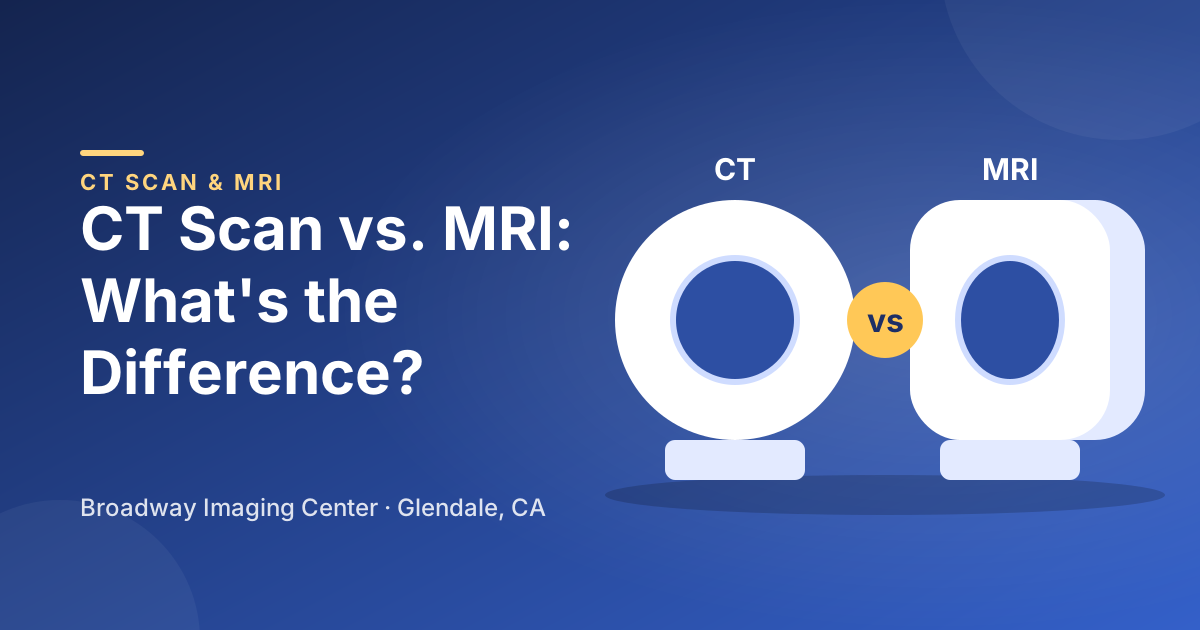
CT scanners are shaped like a short, open ring, so most patients do not feel enclosed. Traditional MRI scanners have a longer tunnel, which some patients find uncomfortable. An Open MRI offers a more open alternative for eligible exams.
When Do Doctors Choose CT vs. MRI?
Your doctor chooses the test based on your symptoms, the body part involved, your medical history, and how quickly results are needed. Some common patterns:
Situation | Often ordered first |
|---|---|
Suspected broken bone or complex fracture | CT (or X-ray) |
Chest or lung concerns | CT |
Abdominal pain or suspected kidney stones | CT |
Back pain with numbness, tingling, or suspected disc problem | MRI |
Knee or shoulder injury, such as a torn ligament or meniscus | MRI |
Headaches or neurological symptoms needing detailed brain views | MRI |
Follow-up imaging where avoiding radiation matters | MRI |
These are general examples, not rules. In some cases, a doctor orders both tests because each answers a different question. Always follow your physician’s recommendation.
Safety, Contrast, and Preparation
Tell the Team About Pregnancy
Let your doctor and the imaging team know if you are pregnant or may be pregnant. This affects which test is appropriate and how it is performed.
Metal and Implants (MRI)
Because MRI uses a powerful magnet, you will be screened for pacemakers, implanted devices, surgical hardware, and metal fragments before your exam. Many implants are MRI-safe under specific conditions, but the team must confirm this first. CT does not have the same magnetic safety concerns.
Contrast Material
Some CT and MRI exams use contrast to highlight blood vessels, organs, or abnormalities. CT uses iodine-based contrast, while MRI uses gadolinium-based contrast. Tell the team about any previous contrast reactions, allergies, or kidney problems.
Fasting and Other Instructions
Preparation varies by exam. Some require no special steps, while exams with contrast may require you to avoid eating for a few hours beforehand. Review our Procedure Preparation page and call us if anything is unclear.
Open MRI and CT Scans in Glendale, CA
If you feel anxious in enclosed spaces, an MRI tunnel can be a real concern. Broadway Imaging Center offers an Open MRI system with 1.2 Tesla technology and approximately 270 degrees of open space, designed to feel less confining while still producing detailed diagnostic images for eligible exams.
Patients choose Broadway Imaging Center for:
- Both CT and Open MRI under one roof, so your doctor’s order can be handled in one place
- A more comfortable MRI experience for patients with claustrophobia
- Clear preparation guidance before every appointment
- A convenient Glendale location serving Burbank, Pasadena, Eagle Rock, and surrounding communities
- Additional services including ultrasound, digital X-ray, DEXA, and digital mammography
Frequently Asked Questions About CT and MRI
Is a CT scan or MRI better?
Neither is better overall. CT is often preferred for bones, lungs, and urgent injuries, while MRI is often preferred for the brain, spine, joints, and soft tissue. Your doctor orders the test that best answers your medical question.
Which is faster, CT or MRI?
CT is faster. The scan often takes only a few minutes, while an MRI usually takes 20 to 60 minutes.
Does a CT scan use radiation?
Yes. CT uses X-rays, a form of ionizing radiation, at a controlled dose. MRI does not use ionizing radiation.
Can I get an MRI if I have metal in my body?
Possibly. Tell the imaging team about any implants, devices, or metal fragments. They will confirm whether an MRI is safe for you before the exam.
Can I choose between a CT scan and an MRI?
The type of exam is determined by your physician’s order. If you have concerns about radiation, claustrophobia, or implants, discuss them with your doctor, who can decide whether another test is appropriate.
Will my insurance cover a CT or MRI?
Coverage depends on your plan, and some exams require prior authorization. Visit our Insurance Information page or call us to check before your appointment.
Schedule a CT Scan or Open MRI in Glendale, CA
CT and MRI are both powerful diagnostic tools, and the right one depends on what your doctor needs to see. If you have an order for either exam, Broadway Imaging Center can help you schedule, prepare, and feel comfortable throughout your visit.
Broadway Imaging Center
140 N Glendale Ave
Glendale, CA 91206
Phone: 818-548-0022
Learn more about our CT Scan and Open MRI services, or contact us to book your appointment.
Medical disclaimer: This article provides general educational information and is not a substitute for medical advice. Always follow the instructions provided by your physician and imaging center.
Sorry, the comment form is closed at this time.