16 May Open MRI vs. Closed MRI: Which Is Right for You?
Introduction
For many people, the hardest part of getting an MRI is not the scan itself. It is the idea of lying inside a narrow tunnel for 30 minutes or more. If you feel anxious in enclosed spaces, you are not alone, and you may have more options than you think.
At Broadway Imaging Center in Glendale, CA, we offer Open MRI for patients who want a less confining experience. This guide compares open MRI vs. closed MRI, explains who benefits most from each, and shares practical tips for staying comfortable during your scan.
Open MRI vs. Closed MRI at a Glance
| Closed MRI | Open MRI |
|---|---|---|
Design | Long, narrow tube with openings at each end | Open sides with a wide, airy scanning area |
Feeling of enclosure | Can feel confining for some patients | Less confining; you can see the room around you |
Best for | A wide range of exams, including some specialized studies | Patients with claustrophobia or anxiety, larger patients, and many routine exams |
Radiation | None | None |
Noise | Loud tapping and knocking | Loud tapping and knocking (ear protection is used) |
Safety screening for metal | Required | Required |
What Is a Closed MRI?
A closed MRI is the traditional scanner most people picture: a long, cylinder-shaped tube. You lie on a table that slides into the tube, and the area being scanned is positioned at its center.
Closed MRI systems are widely used and can perform a broad range of exams. However, the tunnel can feel tight, especially for patients who are claustrophobic, have a larger body frame, or have trouble lying still in a confined space.
What Is an Open MRI?
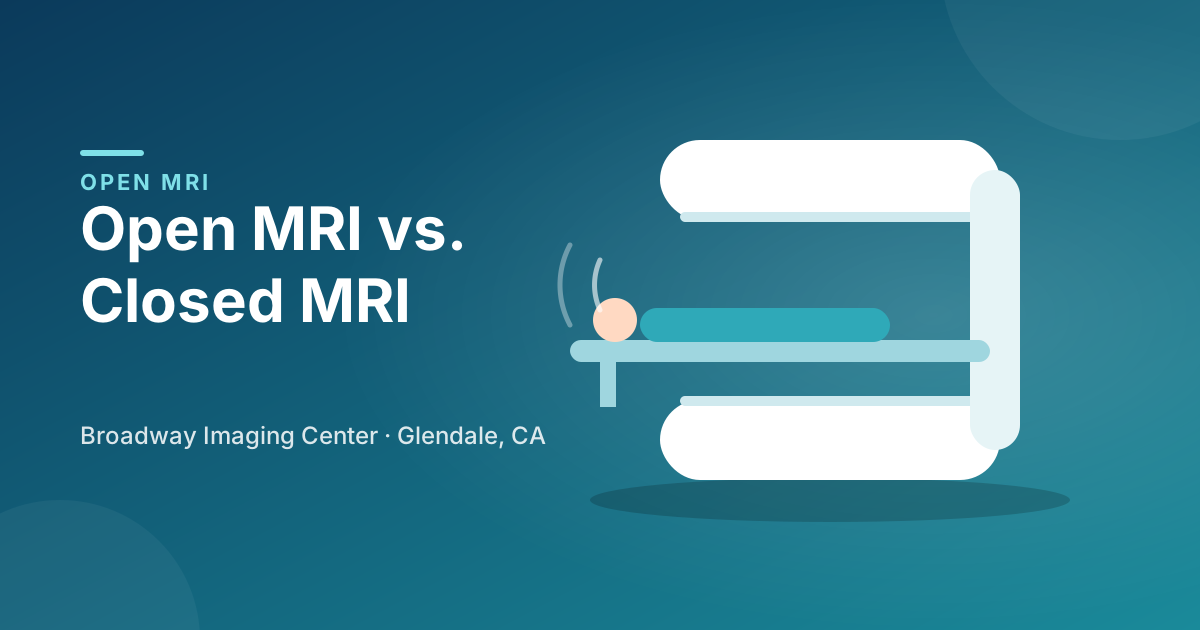
An Open MRI uses a different magnet design that leaves the sides of the scanner open. Instead of being surrounded by a tube, you lie between two magnet surfaces with open space around you.
Broadway Imaging Center’s Open MRI features 1.2 Tesla technology and approximately 270 degrees of unobstructed open space. That openness lets many patients see the room, feel less closed in, and stay more relaxed during the exam.
Who Benefits Most From an Open MRI?
An Open MRI may be a good fit if you:
- Experience claustrophobia or have felt anxious during a previous MRI
- Have a larger body frame and find traditional scanners uncomfortable
- Feel anxious about medical procedures in general
- Have difficulty lying in a tight space because of pain or limited mobility
- Are an older adult who may feel more at ease in an open environment
If you identify with any of these, mention it to your doctor and to our scheduling team. We can talk through whether Open MRI is appropriate for your exam.
Is an Open MRI as Good as a Closed MRI?
This is the most common question patients ask. Image quality depends partly on magnet strength, which is measured in Tesla (T). Many older open MRI systems used lower-strength magnets. Broadway Imaging Center’s 1.2T Open MRI is designed to deliver detailed diagnostic images while keeping the open design patients prefer.
For many routine exams, such as the spine, knees, shoulders, hips, and brain, an Open MRI can provide the images your doctor needs. Some specialized exams may still be better suited to a particular closed scanner. Your physician and our imaging team will help determine whether Open MRI meets your diagnostic needs.
Tips for a Comfortable MRI If You’re Claustrophobic
- Tell us when you schedule. Letting the team know ahead of time helps us plan for your comfort.
- Ask about Open MRI. It may be an option for your exam.
- Visit the restroom first. It is easier to stay still and relaxed when you are comfortable.
- Practice slow breathing. Breathe in for four counts and out for six to help calm your nervous system.
- Keep your eyes closed if seeing the scanner makes you uneasy.
- Use ear protection to soften the machine’s tapping and knocking sounds.
- Talk to your doctor about medication. If your physician prescribes something for anxiety, follow the instructions and arrange a ride home.
For a full walkthrough of the appointment, read What to Expect During an MRI.
Frequently Asked Questions About Open MRI
Is an open MRI better for claustrophobia?
Many patients with claustrophobia find an Open MRI more comfortable because the sides are open and they can see the room. Individual experiences vary, so let the team know about your concerns.
Is an open MRI as accurate as a closed MRI?
For many routine exams, an Open MRI provides the detailed images doctors need. Accuracy depends on the exam type and the scanner’s magnet strength. Your physician will confirm that Open MRI is appropriate for your exam.
Does an open MRI take longer?
Scan time depends on the body part and the imaging protocol. Many MRI exams take approximately 20 to 60 minutes. Our team can give you a more specific estimate.
Is an open MRI loud?
Yes. All MRI machines make tapping and knocking sounds during the scan. Ear protection helps reduce the noise.
Can I request an open MRI?
Yes. You can ask your doctor and our scheduling team whether Open MRI is suitable for the exam you have been ordered.
Does insurance cover an open MRI?
Coverage depends on your plan and the exam ordered. Visit our Insurance Information page or call us to verify.
Schedule an Open MRI in Glendale, CA
You should not have to dread your MRI. If your doctor has ordered one and you are worried about feeling closed in, Broadway Imaging Center’s Open MRI may help you feel more at ease.
Broadway Imaging Center
140 N Glendale Ave
Glendale, CA 91206
Phone: 818-548-0022
Learn more about our Open MRI services or contact us to schedule.
Medical disclaimer: This article provides general educational information and is not a substitute for medical advice. Always follow the instructions provided by your physician and imaging center.
Sorry, the comment form is closed at this time.